


Pause, regulate your own breathing, and acknowledge the other person’s emotion out loud. Then offer one calm, clear next step. This works because emotional states are contagious in close-quarters conflict. A raised voice tends to raise the volume of everyone in the room, but a steady one can pull the temperature back down. In the early moments of a tense exchange, your job isn’t to win a point. It’s to stop the spiral.
While you do that, avoid a few common traps:
- Don’t argue facts or correct details while emotions are running high.
- Don’t mirror their tone, volume, or speed, even to seem “engaged.”
- Don’t crowd their personal space or block an exit path.
Key Takeaways
Effective de-escalation at work depends on regulating your own emotional state first, then using empathy and clear boundaries together rather than choosing one over the other.
| Point | Details |
|---|---|
| Regulate before you respond | A calm voice and slow breath stabilize the interaction before you say a word. |
| Name the emotion out loud | Acknowledging frustration directly often lowers its intensity within seconds. |
| Use the six-second pause | A strategic pause with lower pitch helps defuse emotional spikes better than filling silence. |
| Know the disengagement signals | Threats, stalking, or physical aggression mean stop de-escalating and get help immediately. |
| Practise in short, frequent bursts | Two-to-five-minute roleplay sessions build retention better than annual workshops. |
Table of Contents
- What is de-escalation at work, and why does it matter?
- What are the core skills for de-escalating conflict?
- How can you tell a workplace conflict is escalating?
- What should you say to de-escalate a tense conversation?
- When should you stop de-escalating and set a firm boundary?
- How do these tactics play out in real workplace scenarios?
- How do you build de-escalation skills that actually stick under pressure?
- Ready to build these skills as a team?
- What actually separates good de-escalation advice from noise?
- Sources
What is de-escalation at work, and why does it matter?
De-escalation at work is the deliberate use of calm behaviour, language, and body positioning to lower tension before a workplace conflict turns into a confrontation, complaint, or safety incident. It sits alongside broader conflict resolution techniques, but it’s narrower and faster: you’re managing the next 90 seconds, not the underlying dispute. Negotiation research from Harvard Law School’s Program on Negotiation finds that trying to “win” an argument in the moment almost always makes things worse. Better outcomes come from managing emotion first and uncovering the real interest behind the outburst second.
What are the core skills for de-escalating conflict?
These seven tactics form the practical backbone of workplace conflict management. Practise them in order. Each builds on the one before it.
- Self-regulate first. Take one slow breath before you speak. A calm nervous system is contagious, and HR leadership research notes that leaders who regulate themselves first stabilize the whole interaction. Script: “Give me one second.”
- Listen actively, then paraphrase. Repeat back what you heard before responding. Script: “So what you’re telling me is the order arrived late and nobody called you. Is that right?”
- Name the feeling. Naming an emotion out loud often reduces its intensity. Script: “It sounds like you’re frustrated, and honestly, that’s fair.”
- Ask curious, not defensive, questions. Neutral questions surface the actual interest behind the complaint, which PON’s conflict resolution guidance identifies as more productive than debating who’s right. Script: “What would need to happen for this to feel resolved?”
- Control your pacing and voice. Slow down and drop your pitch slightly. It signals safety, not submission.
- Offer small, real choices. Options restore a sense of control. Script: “I can refund this today or replace it by Thursday. Which works better?”
- Frame the problem as shared. Shift from “you versus me” to “us versus the problem.” Script: “Let’s figure out how to fix this together.”
Pro Tip: Rehearse the naming-the-feeling script out loud, alone, before you need it. It feels awkward the first few times you say it to a mirror, which is exactly why you should practise it there and not in front of an angry customer.
How can you tell a workplace conflict is escalating?
Escalation rarely appears out of nowhere. It moves through recognizable stages, and catching it early gives you far more options.
Watch for these cues before someone raises their voice:
- Speech speeding up or getting louder
- Jaw clenching, arms crossing tightly, or fists forming
- Repeated glances toward the door (a subconscious exit scan)
- Standing closer than usual or squaring shoulders toward you
- Short, clipped answers replacing full sentences
A simple four-stage model helps you match your response to the moment: calm (normal conversation, no intervention needed), agitation (voice and pace rising, use active listening and naming), escalation (loud, repetitive, or accusatory, use firm boundaries and options), and crisis (threats or physical aggression, disengage and get help). Vanderbilt’s verbal de-escalation training outlines a similar stepwise sequence combining breathing, stance, and scripted phrasing.
One distinction matters here: someone who’s distressed usually responds to empathy and slows down once heard. Someone who’s deliberately aggressive, testing limits or trying to intimidate, often needs a firmer boundary sooner rather than more listening.

What should you say to de-escalate a tense conversation?
The words matter less than most people assume. Tone, pacing, and timing do more of the work.
- Paraphrase and name it together: “You’ve called three times about this and nobody’s fixed it. That would frustrate me too.”
- Use “I” statements for feedback: “I noticed the report went out without the updated figures, and I want to understand what happened.” Not: “You keep messing this up.”
- Offer solutions in pairs: “I can either escalate this to my manager right now, or walk you through a fix myself. Your call.”
- Use the six-second pause. Research on conflict resolution skills shows that a strategic pause of roughly six seconds, paired with a lower pitch and slower rate, helps de-escalate an emotional spike better than filling the silence.
- On the phone, slow down more than you would in person. Without facial expressions, your tone carries the entire message.
- In person, silence is a tool. Let a pause sit instead of rushing to fill it. It often prompts the other person to lower their own volume without being asked.
Pro Tip: If you’re managing tone over async channels like Slack or email, add one extra clarifying line before hitting send. Written tone lands flatter and angrier than intended far more often than spoken tone does, a pattern explored in Gatherilla’s breakdown of remote team tone. For more detailed phrasing across scenarios, Streetsafeselfdefence’s de-escalation scripts for real confrontations walk through full exchanges word for word.
When should you stop de-escalating and set a firm boundary?
Empathy and accountability work together, not against each other. Stay soft on the person while staying firm on the behaviour.
- State the boundary plainly and once. “I want to help you, and I need you to stop raising your voice for this conversation to continue.”
- Watch for signals that mean disengage now: explicit threats, stalking or following, sustained intimidation, or any physical aggression. None of these call for more listening.
- Protect your space physically. Keep distance, keep a barrier like a counter or desk between you, and keep an exit route open. Guidance from Victoria Police on aggressive customers recommends exactly this: stay calm, listen, offer solutions, but protect personal safety and call for help if the behaviour doesn’t change.
- Document immediately after. Note the time, what was said, and who witnessed it, while it’s fresh.
- Report and follow up. Loop in a manager or security, and check in with anyone affected a day or two later.
Streetsafeselfdefence’s guide on what happens when de-escalation fails covers this handoff in more depth.
How do these tactics play out in real workplace scenarios?
- Angry customer at the counter: Acknowledge the wait, name the frustration, offer two concrete options. If they reject both and keep raising their voice, hand off to a supervisor rather than absorbing more of it yourself.
- Coworker conflict over a missed deadline: Take it to a private space, not an open floor. Use an “I” statement about impact, not character, and end with a shared next step so the working relationship survives the conversation.
- Upset supervisor over a mistake: Offer a choice in how you’ll fix it, confirm the plan in writing afterward, and follow up within a day. On video calls, slow your pace even more than you would face to face; lag and muted mics already strip out most emotional nuance.
How do you build de-escalation skills that actually stick under pressure?
Reading scripts once won’t make them automatic. Peer-reviewed training research on teaching de-escalation in graduate medical education found structured practice measurably improves safety outcomes and skill retention. Short, frequent practice beats long, rare workshops.
- Run two-to-five-minute micro-practices weekly, not one long annual session.
- Roleplay real scenarios with a partner who gives direct feedback afterward.
- Build a short de-escalation checklist into new-hire onboarding.
- Add an incident-reporting step so patterns get caught before they repeat.
Streetsafeselfdefence’s mobile, trauma-informed workshops bring this exact practice model onsite in as little as five hours, built around scripts your team can rehearse together rather than read once and forget.
Ready to build these skills as a team?
Reading about de-escalation and being able to hold your ground calmly in a real confrontation are two different skills, and only practice closes that gap. Streetsafeselfdefence runs mobile, trauma-informed training sessions for corporate teams, real estate offices, schools, and individuals, bringing the instruction directly to your workplace instead of asking staff to travel. Sessions combine the scripts and boundary-setting techniques covered here with hands-on practice, so the skills hold up under real pressure, not just in a quiet meeting room.
If your team handles the public, manages high-stress client relationships, or simply wants more confidence in tense moments, book a self-defence training session or explore Streetsafeselfdefence’s full training options to find the right fit for your group.
What actually separates good de-escalation advice from noise?
Most workplace training treats de-escalation as a script problem: memorize the right phrases and you’re covered. That’s backwards. The phrasing matters far less than most guides suggest. What actually predicts whether a tense moment cools down or boils over is whether the responder regulated their own nervous system first, because emotional states transfer between people faster than words do.
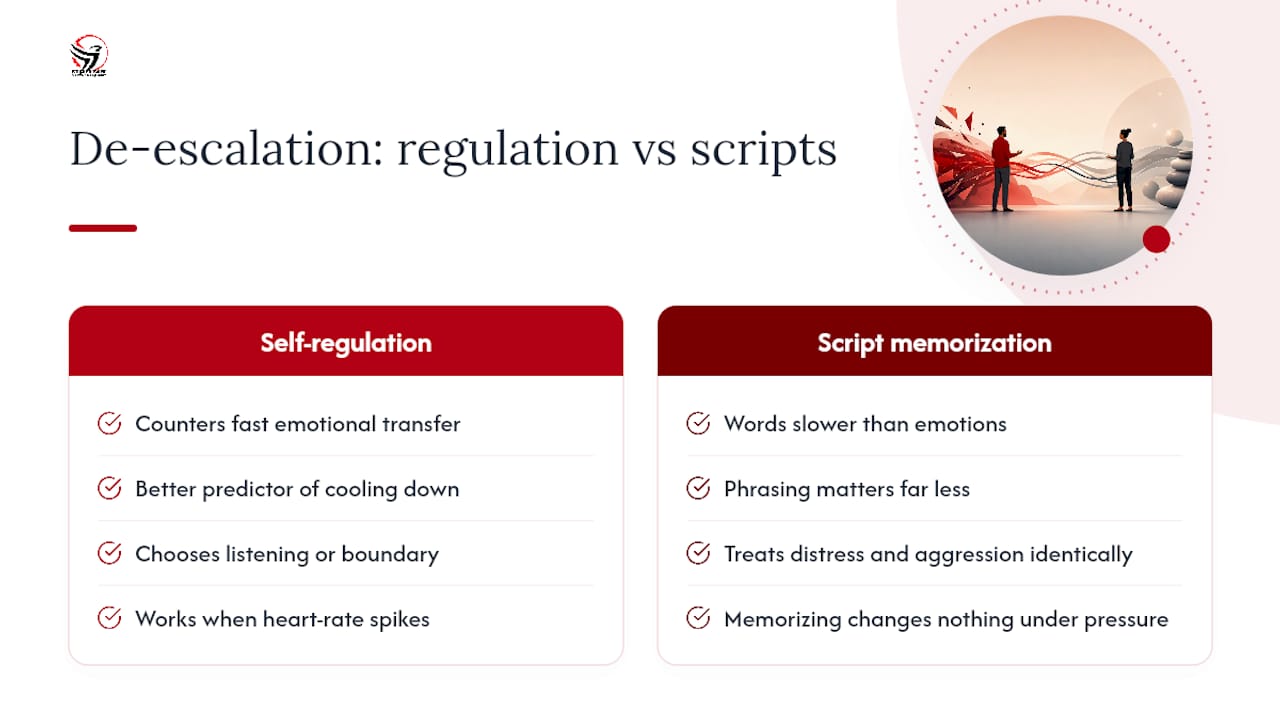
The conventional advice also underplays one distinction: distress and deliberate aggression aren’t the same problem, and treating them identically wastes your best tool. Someone overwhelmed needs to be heard. Someone testing your limits needs a boundary, stated early and calmly, not a longer listening session.
If you take one thing from this guide, prioritize the practice over the theory. Reading scripts changes nothing under real pressure. Rehearsing them, even awkwardly, in a five-minute roleplay with a colleague, is what makes them available to you when your own heart rate spikes. Skill under stress is built the same way any other skill is: through repetition, not comprehension.
— Rob
Sources
- 5 Conflict Resolution Strategies That Actually Work – PON – Program on Negotiation at Harvard Law School
- Promoting Workplace Safety: Teaching Conflict Management and De‑Escalation Skills in Graduate Medical Education
- Respond to aggressive customers | Victoria Police
- Conflict Resolution Skills: 9 Science‑Backed Tips for Any Argument