

A stalking safety plan is a written strategy for reducing risk, organizing evidence, and preparing an exit if things escalate. If you’re in immediate danger, call 911. Otherwise, start now: preserve evidence, tell one trusted person, and contact a victim services advocate before you do anything else.
TL;DR:
- Keep an incident log with dates, times, and evidence links, and photograph all physical evidence with a timestamp before discarding or moving it.
- Regularly review and practice retrieving your go-bag, validate your trusted contacts and code words, and keep digital privacy settings up-to-date.
- Adapt your safety tactics depending on the environment, such as changing door locks at home, notifying security at work, or varying routes in public spaces.
- Use the SHARP risk assessment tool and monitor escalation signs like threats or increased contact frequency to determine if immediate relocation is necessary.
- Engage with victim services and law enforcement, maintaining detailed evidence for reports, and rehearse your safety plan regularly to ensure effective response during high-stress situations.
Table of Contents
- What a stalking safety plan actually does
- Core components every plan needs
- Adapting your plan for home, work, public spaces, and online
- Assessing risk with SHARP and reading escalation signs
- Working with police, courts, and victim advocates
- Practising and updating your plan so it holds up under stress
- Where to find assessment tools, templates, and 24/7 help
- Mental health resources and coping strategies
- Safe housing and relocation options
- Keeping children and family members safe
- Finding community and support groups
- Why rehearsal is the piece most plans skip
- How hands-on training strengthens the plan you’ve built
- Sources
What a stalking safety plan actually does
A stalking safety plan is not a legal document, and it can’t guarantee your safety. Think of it as a personalized, living set of instructions you write for yourself, built to be updated as your situation changes. It exists to reduce risk, keep your evidence organized, and prepare realistic escape options before you need them, not after.
This is different from a protective order, which a court issues and enforces. Your plan works alongside legal protection, not instead of it.
Keep at least one copy offsite with someone you trust completely, and a backup somewhere your stalker can’t access, like a password manager or encrypted cloud folder your abuser doesn’t know exists. If your primary device is compromised, you still need a way to reach your plan.
Core components every plan needs
A workable plan has five parts. Skip one, and the whole structure gets weaker.
Incident log and evidence. Keep a chronological record of every contact, sighting, message, or gift, with dates, times, and locations. Save screenshots, voicemails, texts, and photos of any physical items left behind. Log entries immediately, memory fades fast and courts favour contemporaneous records over reconstructions written weeks later.
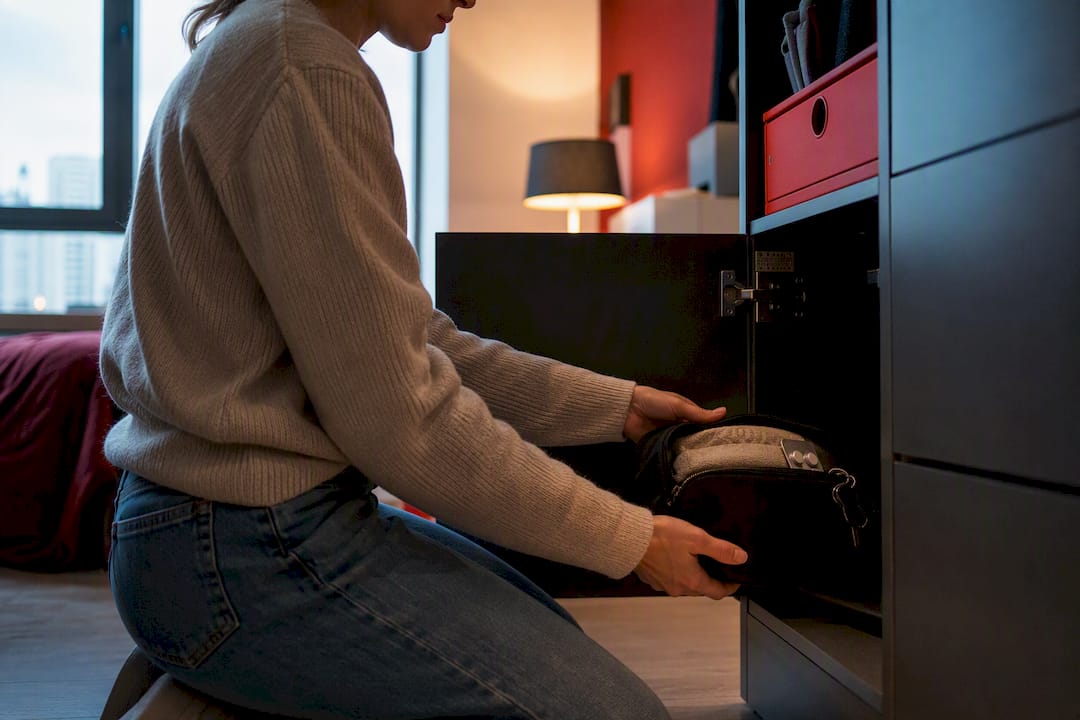
Go-bag contents. Justice Canada recommends packing identification, medications, cash, a change of clothing, and copies of important documents in a bag you can grab in under a minute. Store it somewhere accessible but not obvious, a car trunk, a locker at work, or with the trusted contact from your plan.
Trusted contacts and code words. Choose two or three people who know your situation and agree on a simple code word or phrase that signals “call for help” without tipping off anyone nearby.
Digital privacy checks. Review your phone for unfamiliar apps, check your social media privacy settings, and confirm your location sharing is off for anyone you haven’t explicitly approved.
Offsite backups. Give a trusted person a paper and digital copy of your entire plan, including the incident log.
- Incident log with dates, times, locations, and evidence links
- Go-bag: ID, medication, cash, keys, phone charger
- Two trusted contacts with a shared code word
- Device and privacy checklist reviewed monthly
- One offsite copy of the full plan
Pro Tip: Photograph every physical piece of evidence, unwanted items, damaged property, notes left behind, immediately, with a timestamp visible in frame, before you move or discard anything.
Adapting your plan for home, work, public spaces, and online
Your risk looks different depending on where you are, so your tactics need to shift with the setting.
- At home: Change locks if your stalker has ever had access, install a doorbell camera if you can, and identify two exit routes from your home in case the front door isn’t safe to use.
- At work or school: Notify HR, campus security, or your school administrator directly, and provide a current photo of the person along with a brief description of the situation. This lets front-desk and security staff act fast instead of guessing.
- In public spaces: Vary your routine, routes to work, grocery stores, gym schedule, and travel with someone else when possible. Check in with a trusted contact when you arrive somewhere and again when you leave.
- Online: Check your devices for tracking software, tighten privacy settings on every social platform, and if you suspect your phone or computer is being monitored, use a different, safe device to seek help or change passwords. Canadian government guidance is specific on this point: don’t attempt sensitive actions on a device you believe is compromised.
Assessing risk with SHARP and reading escalation signs
Not every stalking situation carries the same urgency, and your plan should reflect that. Watch for direct threats, weapons access, and contact that keeps increasing in frequency despite no response from you. Any of these signals means it’s time to reassess immediately, not wait for your next scheduled review.
The SHARP tool, built by the University of Kentucky’s Center for Research on Violence Against Women, is a free 48-item web-based assessment that identifies situational risk factors linked to escalation. It’s most useful when you complete it with a victim advocate rather than alone, since a professional can put the results in context you might miss on your own. If your results point to high risk, that’s your signal to prioritize immediate relocation over ongoing monitoring.
Working with police, courts, and victim advocates
Your incident log becomes your strongest asset the moment you involve police or courts. Bring dated entries, saved messages, and photographed evidence to every report, and ask for a copy of the report number for your own file.
Victim services advocates, often available through local police departments or community organizations, help you build and adjust your plan with someone who has seen similar cases play out. SPARC’s guidance stresses trusting your instincts and leaning on advocates rather than navigating this alone.
Protection orders can prohibit contact and restrict access to certain places, but what they cover varies by jurisdiction, and enforcement isn’t automatic. If a violation happens, report it immediately with documentation. Once you have an order, send copies to your workplace’s HR or security team so they know to act if the person shows up.
Practising and updating your plan so it holds up under stress
A plan you’ve never rehearsed will fail you exactly when you need it most. The Hotline’s safety planning research points to outdated, unrehearsed plans as one of the most common gaps survivors face.
Review your plan every few months, and immediately after any life change, a new job, a move, a new relationship, since these shifts can alter your risk without you realizing it. Practise retrieving your go-bag in under a minute, walk your escape routes, and confirm your trusted contacts still remember the code word.
Where to find assessment tools, templates, and 24/7 help
You don’t have to build this from scratch. Several resources exist specifically to help you structure a plan and act fast.
- The SHARP assessment for structured risk evaluation
- Justice Canada’s sample safety-plan templates for incident logs, code words, and go-bag checklists
- SPARC’s guidance page for what to do right now if you’re being stalked
- Local victim services offices, usually reachable through police non-emergency lines, for advocate support and referrals
- Canada for checking devices and locking down accounts
If you organize an event or workplace and want a structured way to think through risk exposure more broadly, Jigsaw Conferences’ overview of event risk assessment offers a useful parallel framework for spotting vulnerabilities before they become incidents.
Mental health resources and coping strategies
Living under stalking takes a toll that doesn’t show up in an incident log. Hypervigilance, disrupted sleep, and constant low-grade anxiety are common, and they’re not a sign you’re overreacting, they’re a normal response to an abnormal situation.
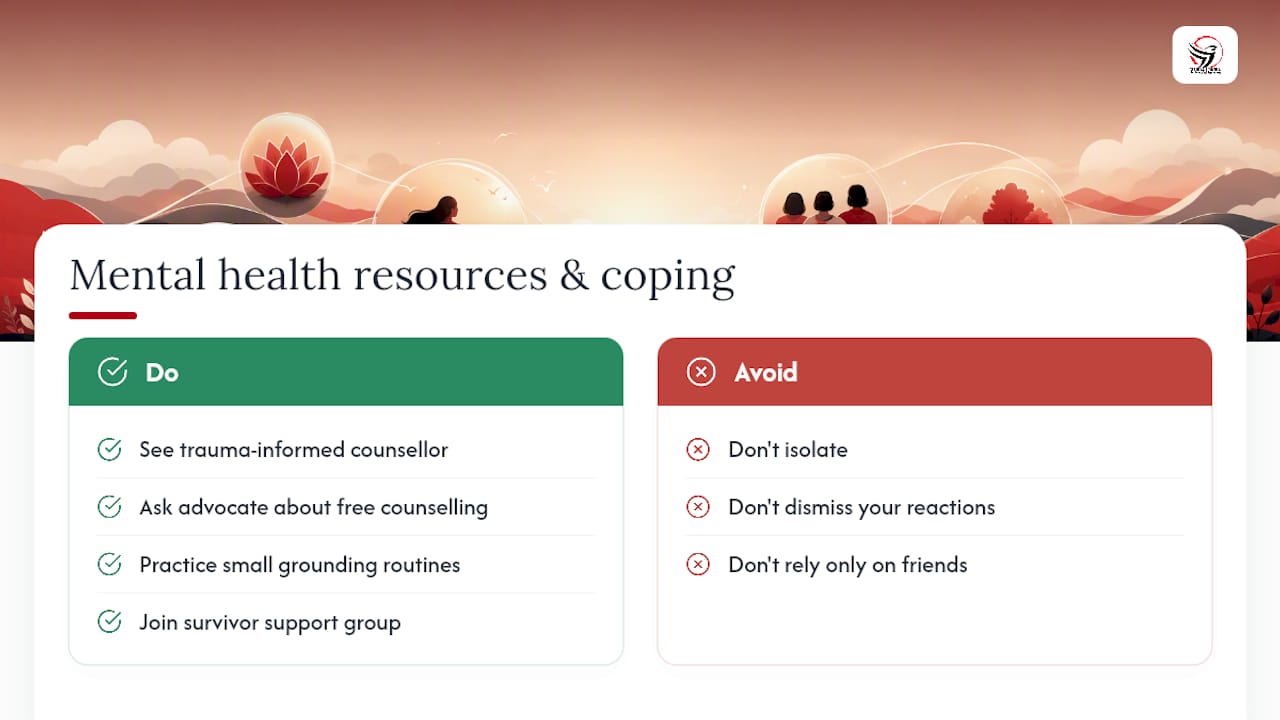
Talk to a counsellor who has experience with stalking or trauma specifically, not just general anxiety. Many victim services organizations offer free or low-cost counselling as part of their support, so ask your advocate what’s available before assuming you have to pay out of pocket.
Build small, repeatable coping routines you can use anywhere: a grounding exercise you do during a panic spike, a breathing pattern you practise before checking your phone, a short walk you take after an unsettling encounter. These don’t fix the underlying threat, but they keep your nervous system from staying in a constant state of alarm, which makes clear decision-making harder over time.
Peer support matters too. Talking with someone who has been through stalking themselves often provides a kind of validation that well-meaning friends and family can’t quite offer, because they haven’t lived the specific mix of fear and disbelief that comes with being watched. Ask your local victim services office whether they run or know of a survivor support group nearby.
Don’t isolate. Stalkers often work to cut you off from your support network, sometimes directly, sometimes just by making you feel like you’re overreacting. Staying connected to people who believe you is part of your safety plan, not separate from it.
Safe housing and relocation options
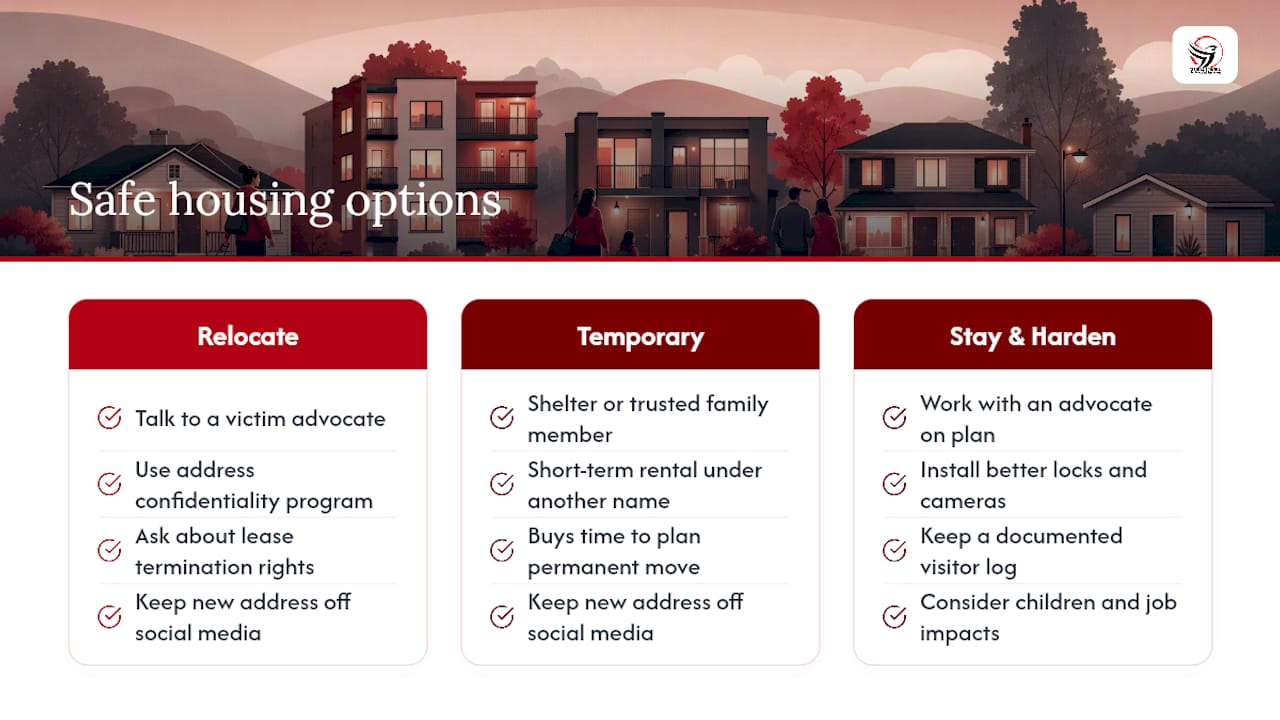
Sometimes the safest move is a new address, and that decision deserves the same planning rigour as the rest of your strategy. Before you relocate, talk to a victim advocate about address confidentiality programs, many jurisdictions offer a system that lets you use a substitute mailing address so your real location doesn’t appear on public records like voter registration or court filings.
If you’re renting, ask your landlord about early lease termination for safety reasons; some provinces have specific protections for tenants facing violence or stalking that let you break a lease without penalty. Keep your new address off social media entirely, and ask friends and family not to tag your location or mention your new city, even in passing.
Temporary housing, through a shelter, a trusted family member, or a short-term rental under someone else’s name, can buy you time to plan a more permanent move without your stalker tracking the transition in real time. If you own property and can’t leave quickly, work with your advocate on interim security measures: better locks, cameras, and a documented log of anyone who approaches your home.
Relocation is a major decision, and it’s not always the right one immediately. Use your risk assessment and your advocate’s input to weigh whether staying and hardening your current home makes more sense than the disruption of a move, especially if you have children in school or a job you can’t easily leave.
Keeping children and family members safe
If you have kids, your plan needs a version built around them specifically, not just folded into your own. Talk to their school the same way you’d talk to your own workplace: notify the principal or administrator directly, provide a photo of the person of concern, and confirm who is authorized to pick your children up.
Teach children age-appropriate versions of your code word system, so if a stranger approaches them claiming to know you, they know exactly what to say or do. Practise this the same way you’d practise a fire drill, calmly, and more than once.
If a family member lives with you or nearby, make sure they know the plan too, where the go-bag is, who the trusted contacts are, and what to do if they see the stalker near your home or theirs. Stalkers sometimes shift focus to family members when direct contact with the victim becomes harder, so don’t assume your relatives are automatically outside the risk.
Custody arrangements complicate this further if you share children with the person stalking you. Document every exchange, keep communication in writing where possible, and talk to a family lawyer or advocate about how to structure handoffs safely, sometimes through a neutral third party or a public location with cameras.
Finding community and support groups
You don’t have to carry this alone, and you shouldn’t try to. Local victim services agencies, often connected to police departments, hospitals, or community health centres, can connect you to support groups specifically for stalking survivors, not just general domestic violence groups, which don’t always address the unique dynamics of being watched or followed.
Online communities can help too, particularly if in-person groups aren’t available where you live, but verify that any group you join is genuinely private and moderated. Some survivors have had stalkers infiltrate open forums, so look for groups vetted by a recognized victim services organization rather than an open public group you found through a search.
Community organizations sometimes offer more than emotional support: legal clinics, help navigating protection orders, or workshops on personal safety strategy that go beyond what you can research alone. Ask your local advocate what’s available in your specific region, since resources vary quite a bit between urban and rural areas.
Why rehearsal is the piece most plans skip
Most people write a stalking safety plan once and never touch it again, and that’s the exact reason plans fail under real pressure. Street Safe Self Defence works with survivors and groups because a written plan and a rehearsed body respond differently. We build practice into training, boundary-setting scripts, phone-ready checks, and device-safety habits, so your plan becomes something your hands know, not just something you wrote down once. If you want that kind of session for your workplace or group, we bring the training to you.
— Rob
How hands-on training strengthens the plan you’ve built
A written plan tells you what to do. Practice is what makes you actually do it when your heart rate spikes and your hands are shaking, which is exactly when a stalking situation tends to escalate. Street Safe Self Defence runs mobile, trauma-informed sessions that come to your workplace, school, or community group, so you’re not adding a commute to an already stressful situation.
Sessions cover assertive boundary scripts you can use the moment contact happens, physical techniques suited to real-world stress rather than choreographed drills, and device-safety habits you can practise alongside your digital privacy checklist. It’s built for people at any fitness level, in as little as five hours, whether you’re an individual working through your own plan or an HR manager arranging support for an employee. Groups can also review our trauma-informed self defence guide for a deeper look at how the training approach is structured.
If you want to rehearse your plan with people trained specifically for this, book a session through Street Safe Self Defence or look into our at-home training option to get started this week.
Sources
- Justice Canada — stalking and harassment guidance
- SHARP — Stalking & Harassment Assessment & Risk Profile (University of Kentucky / CDAR)
- Canada