

When a bullying situation is unfolding right now, five moves matter most: set an assertive verbal boundary, create physical distance without turning your back, recruit a bystander or authority figure, avoid threats or punitive language that can escalate the moment, and document what happened as soon as it’s safe. These aren’t theories. They come from research on bystander programmes, classroom de-escalation practice briefs, and trauma-informed behaviour guidance, and they work because they deny the aggressor the reaction they’re looking for while keeping everyone’s dignity intact.

Know your exit threshold before you need it. If there’s a weapon, a physical assault in progress, or someone is cornered with no way out, skip de-escalation entirely and get to safety or call for emergency help. De-escalation is for the much larger category of verbal conflict, intimidation, and social bullying where calm, practised responses can actually change the outcome.
The strategies covered in this piece include:
- Ranked, step-by-step de-escalation techniques you can use in the moment
- Bystander intervention tactics backed by a recent meta-analysis
- Word-for-word scripts for witnesses, targets, and authority figures
- Trauma-informed principles that prevent re-traumatisation
- Limit-setting habits that stop bullying before it starts
- Workplace-specific adjustments for managers and HR
- Clear thresholds for when to document, report, and involve police
Key Takeaways
Effective bullying de-escalation combines assertive communication, safe bystander action, trauma-informed pacing, and consistent follow-through, with punitive threats avoided during active escalation.
| Point | Details |
|---|---|
| Lead with assertive language | State one clear boundary calmly rather than explaining or matching aggression. |
| Manage distance and body language | Widen space without turning your back, and keep an open, non-confrontational posture. |
| Choose safe bystander actions | Use distraction, delegation, or direct support rather than physical confrontation. |
| Avoid punitive threats mid-incident | Trauma-informed pacing means calming first and addressing consequences later. |
| Document before you report | Record dates, exact words, and witnesses immediately, and save digital evidence with timestamps. |
| Follow up after de-escalation | Check in days later and apply consistent limits to prevent the pattern from resuming. |
Table of Contents
- Bullying de-escalation strategies: a step-by-step approach
- Bystander intervention: what actually helps and what puts you at risk
- Scripts you can practise before you need them
- Trauma-informed de-escalation: what changes when trauma is in the picture
- Setting limits that prevent bullying before it starts
- Adapting de-escalation tactics for adult workplaces
- When de-escalation isn’t enough: documenting and reporting
- How training turns strategies into skills
- Where restorative justice fits into de-escalation
- Getting parents and caregivers involved effectively
- Building prevention habits after a de-escalation succeeds
- Understanding what actually drives bullying behaviour
- Teaching empathy and social skills that reduce bullying long-term
- What the research gets right, and what most advice gets wrong
- Sources
Bullying de-escalation strategies: a step-by-step approach
Most people freeze in a bullying moment not because they lack courage, but because they don’t have a rehearsed sequence to follow. Give yourself one, and the freeze mostly disappears. Here’s the order that research and practice guidance both point to.
1. Lead with assertive, not passive or aggressive, communication. Safe @ School’s guidance on communication styles is blunt about this: passive responses invite more bullying, aggressive responses escalate it, and assertive responses tend to de-escalate it. Assertive means flat, calm, and unapologetic. Your voice stays level. You state what you want, not what you feel about the other person. “Stop talking to me like that” lands very differently than “Why are you always so mean to me?” One is a boundary. The other is an opening for more conflict.
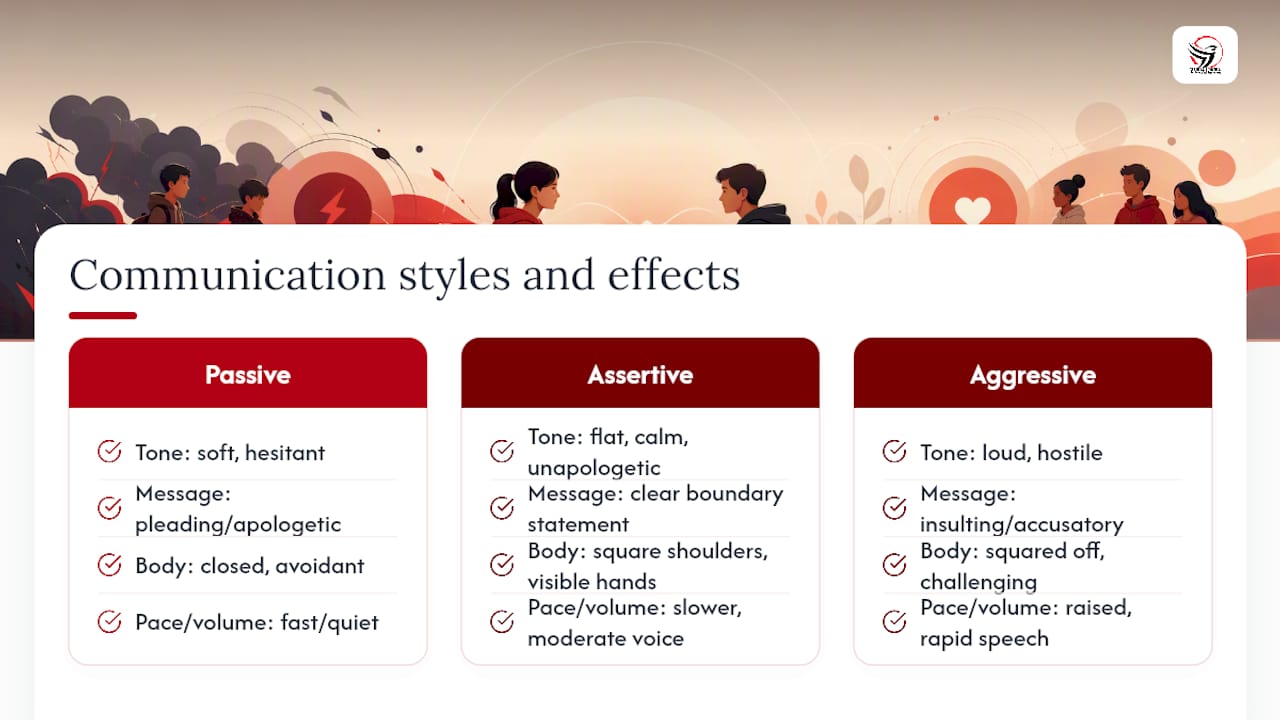
2. Control your body language before you control the conversation. Square shoulders, feet shoulder-width apart, hands visible and relaxed rather than clenched. Keep a slightly open stance rather than squaring off nose-to-nose, which reads as a challenge. Eye contact should be steady, not a hard stare. If you’re a bystander stepping in, position yourself at an angle, not directly between two people head-on. That posture alone can lower the temperature before you say a word.

3. Manage distance strategically. Closing distance can feel like standing your ground, but it often reads as provocation and invites a physical response. Widening distance without turning your back keeps you safe while signalling you’re not looking for a fight. If you’re the target, angling toward an exit as you speak gives you an escape route without looking like you’re fleeing.
4. Use calming, co-regulated pacing. Slow your speech down. Lower your volume slightly rather than matching a raised voice. A brief pause before responding, even two or three seconds, interrupts the back-and-forth rhythm that fuels most verbal escalation. Breathing slower yourself has a spillover effect: people tend to unconsciously mirror the pace of whoever they’re arguing with.
5. Set one clear limit, not a list of grievances. “That’s not okay, stop” beats a paragraph of justification every time. Long explanations sound defensive and give the aggressor more material to argue with. Short, declarative boundary statements are harder to twist.
6. Give the other person a face-saving way out. This is the step most people skip, and it’s often the one that actually ends the confrontation. Public embarrassment is fuel for continued aggression, so offering an exit that doesn’t require public backdown, like redirecting attention or suggesting everyone move on, often works better than a public win. PBIS’s practice brief on classroom de-escalation makes this point directly: avoiding power struggles matters more than winning them.
7. Know your withdrawal trigger and act on it immediately. If your assertive line doesn’t land within two attempts, if the other person’s volume or proximity increases, or if a weapon or object appears, stop de-escalating and disengage. There’s no shame in this. De-escalation has a ceiling, and knowing where it is matters more than pushing past it.
Pro Tip: Practise your one boundary line out loud, alone, before you ever need it. Saying “That’s not okay, I’m not doing this” in the shower or the car rewires it from a thought into a reflex, so it comes out steady under pressure instead of shaky.
The SCIDDLE framework, which stands for Stop, Calm down, Identify, Decide, Do it, Look, Evaluate, gives targets a structured pause sequence that prevents impulsive retaliation. It’s worth memorizing as a backup to the steps above, especially for younger people who benefit from a fixed mental checklist rather than an improvised response. Readers who want to drill these sequences until they’re automatic can find structured practice scripts built specifically for real-time confrontations.
Bystander intervention: what actually helps and what puts you at risk
Bystanders change outcomes more often than most people assume, but only when they act in specific, low-risk ways. Standing by silently is the most common bystander response and also the least helpful one. Direct physical intervention, on the other hand, is often the riskiest and least necessary.
The safer, research-supported middle ground includes a few concrete moves:
- Distraction: interrupt the interaction with an unrelated question or comment (“Hey, do you have the time?”) that breaks the momentum without confronting anyone directly.
- Delegation: find a teacher, manager, security guard, or other authority figure rather than trying to resolve it yourself.
- Direct support of the target: walk up and ask the person being targeted if they want to leave with you, which gives them an exit that doesn’t require them to back down publicly.
- Documentation: if it’s not safe to intervene at all, recording what happens (with awareness of your own safety and applicable laws) can matter later for reporting.
- Delayed check-in: if the moment passes too fast to act, following up with the target afterward still counts as meaningful support.
A 2024 meta-analysis of 49 studies on bystander intervention programmes found something that should reshape how workplaces and schools design training: the programmes that worked best weren’t the longest or most elaborate. They were short, under one month, ran with small groups of fewer than 100 participants, and mixed offline practice with online scenarios. The overall effect size was modest, Cohen’s d around 0.25, which in plain terms means these programmes produce a real but incremental shift, not an overnight transformation. That’s a useful, honest benchmark: bystander training moves the needle, but it works best as one layer in a broader prevention approach, not a stand-alone fix.
Before intervening, run a quick risk check. Is a weapon involved? Is the aggressor significantly larger, more numerous, or visibly out of control? Is this happening somewhere isolated with no adults or authority nearby? If any answer is yes, delegation and documentation are your safest options, not direct confrontation. Online, this translates to reporting a post or comment through the platform, screenshotting before content gets deleted, and privately checking in on the target rather than replying publicly and escalating the thread.
Scripts you can practise before you need them
Reading about de-escalation and having a line ready in your mouth are two different skill levels. These scripts are meant to be said out loud, adjusted to your own voice, and repeated until they feel boring rather than nerve-wracking.
- As the target, setting a boundary: “That’s not okay. Stop.” Nothing more is required. Adding justification invites debate.
- As the target, exiting cleanly: “I’m done with this conversation,” followed by walking away without looking back repeatedly, which can read as inviting continued engagement.
- As a witness, using distraction: “Hey, [name], can you help me with something?” directed at either party, breaking the interaction’s rhythm without naming what’s happening.
- As a witness, checking in privately afterward: “I saw what happened. Are you okay? Do you want to talk to someone about it together?”
- As a manager or teacher, addressing the aggressor without shaming: “I need this conversation to stop right now. Let’s talk one-on-one.” Public shaming often produces defensive escalation rather than accountability.
- As a manager or teacher, supporting the target: “I noticed that interaction. You didn’t deserve that, and I want to help figure out next steps.”
- For digital bullying, responding to a comment or DM directed at you: “I’m not engaging with this. If it continues, I’m reporting it.” Then follow through, calmly and without further reply.
- For digital bullying, as a witness commenting publicly: “This isn’t okay” is often more effective than a long callout, which can trigger pile-on dynamics that escalate rather than resolve the situation.
Role-play these with a friend, partner, or colleague, swapping who plays which role. The goal isn’t to memorize a script word for word. It’s to get comfortable enough with the tone and rhythm that your voice doesn’t shake when the real moment arrives.
Trauma-informed de-escalation: what changes when trauma is in the picture
Punitive threats during an active escalation almost always make things worse, not better. Telling someone “you’re going to get suspended” or “you’ll lose your job over this” while they’re mid-conflict raises their stress response rather than calming it, and a nervous system flooded with adrenaline can’t process consequences rationally in that moment anyway. Trauma-informed practice guidance is direct on this point: the goal during escalation is safety and de-escalation first, accountability later.
Co-regulation is the mechanism that makes this work. A calm adult or bystander who lowers their own voice, slows their own breathing, and avoids sudden movements gives the other person’s nervous system something steady to sync with. Validating language matters here too, and it doesn’t require excusing the behaviour. “I can see you’re really frustrated” acknowledges the emotional state without agreeing that the behaviour is acceptable.
For students with an IEP or BIP, or adults with known trauma histories, the standard script often needs adjusting. A behaviour plan may specify a particular calming space, phrase, or person the individual responds to best, and following it beats improvising in the moment. The same logic applies to adults: someone with a trauma history may need more physical space, a slower pace, or a different tone than a generic script assumes.
- Avoid ultimatums and threats during active escalation; they raise stress rather than lower it.
- Use short, validating phrases that acknowledge feeling without endorsing behaviour.
- Follow individualized plans (IEP/BIP) rather than a one-size-fits-all response.
- If emotions are too high for a productive conversation, pause and schedule a restorative conversation later, once everyone’s regulated.
Pro Tip: If you feel your own frustration rising while trying to de-escalate someone else, that’s your cue to pause too. Co-regulation only works if at least one nervous system in the room is actually calm.
Setting limits that prevent bullying before it starts
The most effective bullying prevention rarely looks dramatic. It looks like consistent, boring predictability, and that’s exactly why it works. When expectations and consequences are clear and applied the same way every time, there’s less ambiguity for anyone to exploit and less anxiety driving reactive behaviour in the first place.
Crisis Prevention Institute’s guidance on limit setting outlines practical habits that hold up in both classrooms and workplaces:
- State expectations clearly and in advance, rather than only after a violation happens.
- Use the same consistent language for consequences every time, so responses feel predictable rather than arbitrary.
- Model the behaviour you expect; adults and managers who lose their temper undermine every rule they’ve set.
- Teach social-emotional skills directly through short, repeated drills rather than assuming they’ll develop on their own.
- Reduce unsupervised or unstructured time in spaces where bullying tends to concentrate, like hallways, locker rooms, or informal break areas.
- Apply consequences consistently across every group and setting, since inconsistency is one of the fastest ways to erode trust in the system.
Social-emotional skill drills don’t need to be elaborate. A five-minute weekly practice where students or team members role-play a boundary-setting conversation builds the same muscle memory as the scripts covered earlier. The boundary-setting skills that protect someone in a one-off confrontation are the same skills that, practised regularly, prevent a pattern of bullying from ever taking hold.
Adapting de-escalation tactics for adult workplaces
School-based scripts need translation before they work in a professional setting, mostly because workplace bullying tends to be quieter, more indirect, and wrapped in plausible deniability. A colleague who consistently interrupts you in meetings or excludes you from key emails is bullying just as much as someone who’s openly hostile, and it calls for the same assertive, documented response.
Private conversations work better than public confrontation in most workplace situations. Pulling someone aside and saying “I need you to stop talking over me in meetings” carries the same assertive weight as a school-based script, without the audience that can turn a moment into a spectacle.
For managers, a short mental checklist keeps a response consistent and fair:
- Document specific incidents with dates, what was said or done, and who else was present.
- Investigate promptly, speaking with the affected employee first and any witnesses separately.
- Protect confidentiality wherever possible, since fear of exposure often stops people from reporting at all.
- Loop in HR when a pattern emerges, not just after a single flashpoint incident.
Digital incidents, an aggressive email, a chat message meant to humiliate, a meeting interrupted repeatedly on purpose, deserve the same documentation standard as an in-person incident. Save the message, note the date and time, and don’t delete the thread even if it’s uncomfortable to keep. Some workplace situations cross into harassment territory, particularly when they involve unwanted advances or repeated targeting tied to a protected characteristic, and that’s a point where legal guidance becomes relevant rather than optional.
When de-escalation isn’t enough: documenting and reporting
De-escalation buys time and safety in the moment. It’s not a substitute for reporting when a pattern is forming or a line has already been crossed. Knowing when to shift from de-escalating to documenting is its own skill.
- Record specifics immediately after any incident: date, time, location, exact words if you can recall them, and names of anyone who witnessed it. Memory fades fast, so writing it down within hours matters more than writing it down thoroughly.
- Save digital evidence before it disappears: screenshot messages, posts, or emails, and include the timestamp and username or sender visible in the frame.
- Organize incidents chronologically in a single document or notebook rather than scattered across notes apps, texts, and memory. A clear timeline is far more persuasive to a school administrator or HR representative than a vague account of “this has been going on for a while.”
- Make your report concise: lead with what happened, when, and who was involved, and attach your documentation rather than narrating every detail verbally first.
- Escalate to police when the situation includes threats of violence, stalking, physical assault, or repeated harassment that persists after a formal report has been filed. KidsHealth’s guidance for teens is consistent on this point: reporting to a trusted adult and avoiding physical retaliation protects you both physically and, later, in any formal process.
- Line up support afterward. A counsellor, employee assistance programme, or trusted friend matters as much as the paperwork. Bullying incidents leave a stress response behind even after they’re resolved on paper.
How training turns strategies into skills
Reading a script is one thing. Delivering it steadily while your heart rate spikes is another, and that gap only closes with practice. Short, hands-on workshops, sometimes as brief as an afternoon, that pair scripted lines with live role-play tend to build responses that fire automatically under pressure, rather than responses you have to consciously think your way through.
- Session formats that work best combine short verbal drills with physical positioning practice, so tone of voice and body language get rehearsed together.
- Participants across different training formats consistently report the same shift: more confidence and a faster, calmer reaction the next time a real confrontation happens.
- Trauma-informed instruction changes the specific phrasing taught, favouring validating, non-shaming language over drill-sergeant style commands.
- When evaluating any training option, prioritize ones built around live practice and repetition over lecture-heavy formats, since that’s the design pattern the research above consistently favours.
Streetsafeselfdefence builds its sessions around exactly this model: mobile, on-site training that runs in as little as five hours and centres on rehearsed, reality-based responses rather than theory.
Where restorative justice fits into de-escalation
Restorative justice isn’t a de-escalation technique in the moment. It’s what happens afterward, once things are calm, and it works alongside the strategies above rather than replacing them. The core idea is straightforward: instead of only punishing the person who caused harm, a restorative process brings the person harmed and the person responsible into a structured conversation, often with a trained facilitator, to address what happened and agree on repair.
This matters for de-escalation specifically because punitive-only responses often set up the next confrontation rather than preventing it. A student suspended without any restorative conversation frequently returns with the same resentment and the same behaviour pattern intact. A restorative conversation, held once emotions have settled, gives the aggressor a chance to understand impact rather than simply serve a consequence, and gives the target a voice in the outcome rather than leaving them to feel the incident just disappeared into a file.
Restorative approaches work best as a deliberate second stage, never a substitute for immediate safety. Nobody should be pushed into a restorative conversation while still activated from the incident itself; that’s when trauma-informed pacing matters most. Scheduling the conversation days later, once both parties can speak calmly, is what makes restorative justice effective rather than performative. Schools and workplaces that pair firm boundary enforcement in the moment with a genuine restorative process afterward tend to see fewer repeat incidents from the same individuals than those relying on punishment alone.
Getting parents and caregivers involved effectively
Parents and caregivers often find out about bullying incidents secondhand, frustrated and afraid, which can push them toward reactions that make things harder rather than easier. Coaching them toward a calmer, more effective role matters as much as coaching the young person directly.
The first habit worth building is listening before acting. A parent who immediately calls the school demanding punishment, before hearing the full story from their child, often misses details that would have changed their approach. Asking open questions, “What happened? What did you do? What do you want to happen next?”, gives the child agency and gives the parent accurate information to work with.
Second, parents do better modelling the same assertive, non-punitive language covered throughout this piece rather than escalating on the child’s behalf. A parent who threatens the other family or shows up angry at the school often makes the situation more volatile, not less, and can put their own child in an awkward position socially.
Third, coordination with the school or workplace matters more than confrontation. A calm, documented conversation with a teacher or administrator, referencing specific incidents rather than general complaints, tends to get faster and more thorough action than an emotional one.
Finally, caregivers should treat this as an ongoing check-in, not a one-time conversation. Bullying situations often continue quietly after the initial report, and a simple weekly “how are things going with that” question keeps the door open without hovering.
Building prevention habits after a de-escalation succeeds
Successfully de-escalating one incident doesn’t mean the underlying pattern is resolved. Long-term prevention depends on what happens in the weeks after, not just the moment itself.
Follow-up check-ins matter more than most people assume. A brief conversation a few days after an incident, checking whether the behaviour has stopped and whether the target feels safe, catches situations that quietly resume once attention fades. Skipping this step is one of the most common reasons bullying incidents recur.
Consistency across the environment matters just as much as the individual conversation. If one teacher, manager, or parent enforces a boundary firmly but others let similar behaviour slide, the inconsistency undermines the whole effort. Everyone involved, teachers across a school, managers across departments, needs to apply the same standard.
Ongoing skill practice keeps the gains from fading. The same short scripts and role-play drills used to prepare for de-escalation work just as well as periodic refreshers, keeping assertive responses sharp rather than letting them atrophy once the immediate crisis passes.
Finally, tracking patterns over time, even informally, helps catch repeat behaviour before it becomes entrenched. A student or employee who’s been involved in multiple incidents across different targets is a different prevention problem than a single isolated conflict, and treating them the same way misses the bigger picture.
Understanding what actually drives bullying behaviour
Bullying rarely comes from nowhere. Understanding the common triggers behind it doesn’t excuse the behaviour, but it does change how effectively you can prevent and de-escalate it.
A need for social status or control is one of the most consistent drivers, particularly in adolescent settings where social hierarchy feels high-stakes. Bullying can function as a shortcut to perceived power, especially for someone who feels powerless elsewhere in their life.
Exposure to aggression at home or in past environments is another common thread. Someone who’s witnessed or experienced harsh, punitive treatment often replicates that dynamic because it’s the model they’ve internalized for handling conflict or asserting themselves.
Unaddressed trauma or unmet emotional needs frequently sit underneath aggressive behaviour, which is exactly why trauma-informed de-escalation, discussed earlier in this piece, treats the moment as one to de-escalate and address later rather than punish immediately.
Group dynamics and bystander silence also fuel the behaviour directly. When peers laugh, stay quiet, or passively go along, it reinforces the bullying as socially rewarded rather than costly, which is part of why the bystander interventions covered above matter so much.
Finally, some bullying is opportunistic rather than deeply rooted, occurring simply because a situation offers an easy, low-consequence target and no one has set a clear enough limit to stop it. That’s precisely the gap the limit-setting strategies in this article are designed to close.
Teaching empathy and social skills that reduce bullying long-term
Empathy isn’t fixed. It’s a skill that responds to deliberate practice, and building it among peers is one of the most durable long-term investments a school or workplace can make.
Perspective-taking exercises, simple prompts like “how do you think that made them feel?”, asked consistently rather than only after an incident, build the habit of considering impact before acting. This works best as a routine practice, not a one-time lesson after something’s already gone wrong.
Structured peer collaboration, working in mixed small groups on shared tasks, tends to reduce the us-versus-them dynamics that fuel exclusion and targeting. People are less likely to bully someone they’ve had to genuinely cooperate with toward a shared goal.
Modelling matters here as much as it does everywhere else in this article. Adults who visibly show empathy in their own conflicts, acknowledging another person’s frustration even while holding a boundary, teach that skill far more effectively than any lesson plan.
Short social skill drills, the same style of five-minute practice recommended in the prevention section, build specific competencies like reading body language, recognizing when someone’s uncomfortable, and knowing how to check in with a peer who seems isolated. These are learnable behaviours, not fixed personality traits, and treating them that way is what makes the training worth the time.
What the research gets right, and what most advice gets wrong
Most bullying advice defaults to theory: understand the root causes, build empathy, foster a positive culture. All of that matters over months and years. None of it helps someone standing in a hallway or a break room right now, mid-confrontation, with no idea what to say. That gap between long-term theory and in-the-moment usefulness is where most guidance quietly fails people.
The meta-analysis on bystander programmes backs up something worth sitting with: the interventions that worked weren’t the most ambitious ones. They were short, specific, and rehearsed. That’s a real contrast to how a lot of school assemblies and corporate training modules are still built, heavy on information, light on practice.
If you take one thing from this article, make it this: pick two or three scripts, say them out loud until they feel automatic, and know your withdrawal trigger before you’re in a moment that requires it. Everything else, restorative conversations, long-term prevention, parent coordination, matters, but it builds on top of that foundation, not instead of it.
— Rob
Sources
- PubMed entry for 2024 meta-analysis on bystander intervention programmes
- Supporting kids to respond to bullying in the moment — Psychology Today
- Escalating and de-escalating bullying — Safe @ School
- Strategies for de-escalating student behaviour in the classroom — PBIS
