

Escape and evasion means the practical skills that let you break an attacker’s grip, create distance, and get to safety without needing to win a fight. The action sequence is short enough to remember under stress: recognize the threat, try verbal de-escalation if it’s safe, create an opening, move to a planned safe place, then call for help.
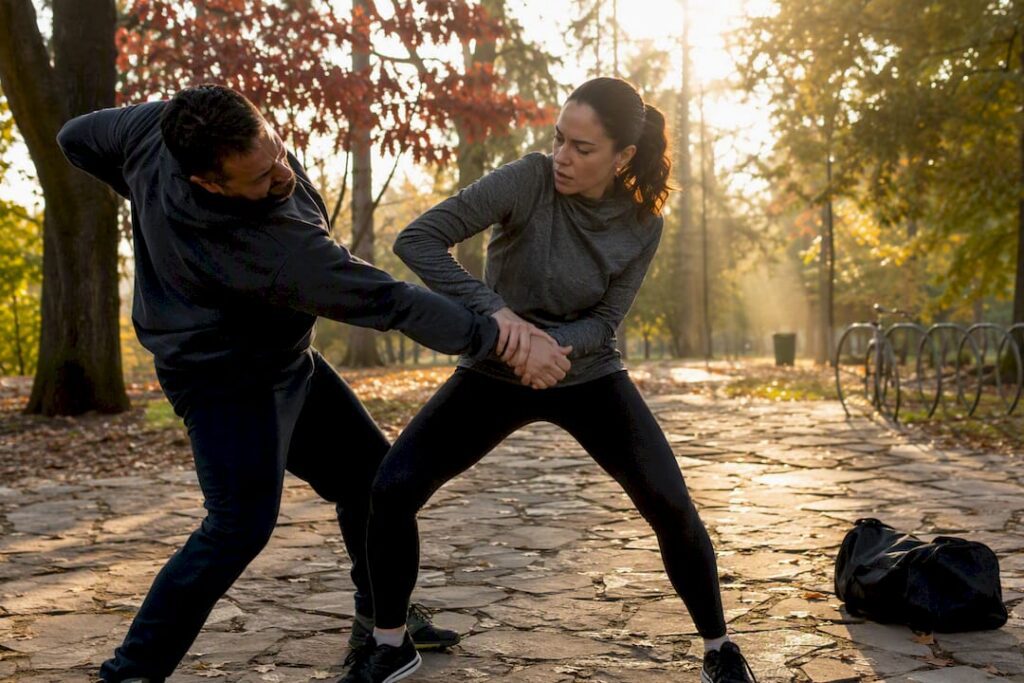
Two moves cover a lot of ground for beginners. If someone grabs your wrist, turning toward their thumb (the weakest point of their grip) breaks the hold with surprisingly little force. If someone squares up to you, stepping off at an angle rather than backing straight up gets you out of easy reach and buys a second to run.
None of this replaces supervised practice. Street Safe Self Defence teaches these exact sequences in five-hour practical courses delivered at your location, so the movements become reflexes instead of ideas you half remember later.
- Recognize the threat early
- Attempt de-escalation only if it’s safe
- Create an opening (break grip, move off-line)
- Run to a pre-identified safe location
- Call for help immediately
Key Takeaways
Escape and evasion succeeds when situational awareness, brief verbal de-escalation, and two or three rehearsed physical openings are combined with a pre-planned route to safety.
| Point | Details |
|---|---|
| Definition matters | Escape and evasion means breaking free, creating distance, and reaching safety, not winning a fight. |
| Train the mindset | Panic undermines good technique, so stress inoculation matters as much as the moves themselves. |
| Plan before you need it | Identify hazards, pick routes and meeting points, and agree on a communication plan in advance. |
| Watch your digital footprint | Turn off real-time location sharing and review family-sharing permissions regularly. |
| Book real practice | Streetsafeselfdefence delivers five-hour, trauma-informed, mobile courses for individuals and groups. |
Table of Contents
- Essential skills: awareness, de-escalation, and immediate escape moves
- Planning for escape and evasion: routes, tools, and communication
- Practising escape and evasion: realistic, trauma-informed training
- If you get away: protecting your safety afterward
- How to choose training that teaches escape and evasion responsibly
- Techniques to avoid detection and tracking after escape
- Psychological preparedness and mindset for high-stress escape scenarios
- Safeguarding your digital footprint during evasion
- What the research actually supports
- Book practical escape and evasion training with Streetsafeselfdefence
- Frequently asked questions
- Sources
Essential skills: awareness, de-escalation, and immediate escape moves
Most confrontations give off warning signs long before they turn physical. A one-minute environment sweep, done automatically, catches most of them: note your exits, notice who’s paying too much attention to you, and check whether your intended path is clear. This isn’t paranoia. It’s the same scan a lifeguard runs on a pool deck, done for your own space instead.
Verbal de-escalation works when the other person still has some capacity to back down. Keep your voice low and even, your hands visible and slightly raised, and your words short: “I don’t want trouble,” or “I’m leaving now.” This is a teachable, skill-based process built on tone and body language rather than charisma, but it only works before things escalate past a certain point. Once someone has crossed into physical contact, words stop being the tool. Streetsafeselfdefence’s de-escalation techniques walk through exact scripts for that narrow window.
When de-escalation fails, three techniques matter more than any strike:
- Grip breaks — rotating against the thumb or weakest point of a hold, rather than pulling straight back against full grip strength.
- Off-line movement — stepping at an angle instead of retreating in a straight line, which most attackers are trained (consciously or not) to follow.
- Releasing bear hugs and holds from behind — dropping your weight and turning into the gap, rather than fighting the strength of the hold directly.
Pro Tip: Practise these moves at slow speed with a partner first, using clear stop signals, before adding any resistance or speed. Escalate intensity only after the movement pattern is automatic.
Rehearse with a partner who understands the stop signal system, and add stress gradually. Jumping straight to full-speed, full-resistance practice is how people get hurt in training instead of learning anything useful.
Planning for escape and evasion: routes, tools, and communication
A short risk assessment beats a vague sense of unease. Identify hazards specific to your routine (a parking garage, a late shift, a walking route), judge how likely and how severe each one is, then choose a control: avoid it, change your route, or get trained for it. That three-step structure mirrors the personal risk assessment approach used in broader safety planning, adapted to individual situations.
Escape routes need to be chosen before you need them, not improvised in the moment. Walk your regular routes once with an eye specifically for exits, well-lit stretches, and businesses that stay open late. Groups (families, coworkers, school classes) benefit from a shared meeting point that everyone can reach without needing directions.
- Keep a charged phone and know your local emergency number by memory, not just by app.
- A whistle is legal almost everywhere and carries farther than your voice.
- Check local regulations before carrying any tool marketed as self-defence equipment.
- Decide in advance who you’d call first and what you’d say in under ten seconds.
Avoid broadcasting your location on social media in real time during an unfolding situation. Geolocated posts can tip off the wrong person before help arrives.
Practising escape and evasion: realistic, trauma-informed training
Technique drilled in isolation doesn’t transfer well to a real threat. Reality-based training works better when it includes role-play in street clothing, unpredictable movement, and realistic stress rather than purely technical solo drills done in a gi on soft mats. That gap between dojo conditions and a parking lot at night is exactly where most self-defence training quietly fails people.
A focused five-hour session, run properly, covers a tight set of skills: situational awareness, two or three grip escapes, off-line movement, and one scenario run-through that puts it all together under mild stress. That’s enough time to build real muscle memory without overwhelming a first-time participant.
Trauma-informed delivery matters because a portion of any group, whether it’s a school class or a corporate team, has lived experience with violence. An instructor trained in this approach gives participants control over their own pace, avoids surprise contact, and checks in throughout rather than assuming everyone starts from the same baseline.
Scenario realism, including street clothing and unpredictable stressors, prepares learners far better for real threats than purely technique-focused drills done in ideal conditions.
After a short course, retention depends on repetition. Five minutes of grip-break drilling twice a week, a scenario night every few months, and a full refresher annually keep the skills sharp. Streetsafeselfdefence’s scenario-based training page outlines what that ongoing practice can look like for individuals and groups.
If you get away: protecting your safety afterward
Getting clear of danger is the first priority, but what happens in the next hour matters too.
- Get to a safe, populated location and contact emergency services or a trusted person immediately.
- Seek medical attention even if injuries seem minor. Some injuries and evidence are only documented properly by a professional.
- Avoid washing, changing clothes, or cleaning up before reporting if there’s any chance of a criminal investigation.
- Report to police, and separately notify your workplace or school if the incident happened in that context.
- Expect an emotional aftermath. Adrenaline crashes hard, and trauma counselling isn’t a sign of weakness. It’s part of recovering fully.
How to choose training that teaches escape and evasion responsibly
Not every self-defence course actually prepares people for a real confrontation. Some focus on choreographed sparring that looks impressive but falls apart the moment someone moves unpredictably.
Look for these markers before booking:
- Scenario-based practice in regular clothing, not just uniform drills on mats.
- A trauma-informed approach with visible safety protocols and clear consent around physical contact.
- Instructors who can explain their credentials and training background without hedging.
- Group-size flexibility for schools, workplaces, or community organizations.
- Mobile delivery, so training happens at your location instead of requiring travel.
Before booking, ask directly: how is stress introduced gradually? What happens if a participant has a trauma history? How many people can the session accommodate? A provider who answers these clearly, rather than deflecting to generic marketing language, is worth trusting. Short, well-structured courses integrate easily into a school’s existing safety curriculum or a company’s onboarding, especially when paired with an annual refresher.
Techniques to avoid detection and tracking after escape
Getting away from an immediate threat is only step one. If pursuit is a real possibility, staying undetected afterward becomes its own skill set. Noise discipline matters more than most people expect: footsteps on gravel, a phone ringing, keys jingling in a pocket all carry farther than you’d think in a quiet area. Practical guides on evasion consistently emphasize noise discipline and concealment as core movement skills that buy critical time.
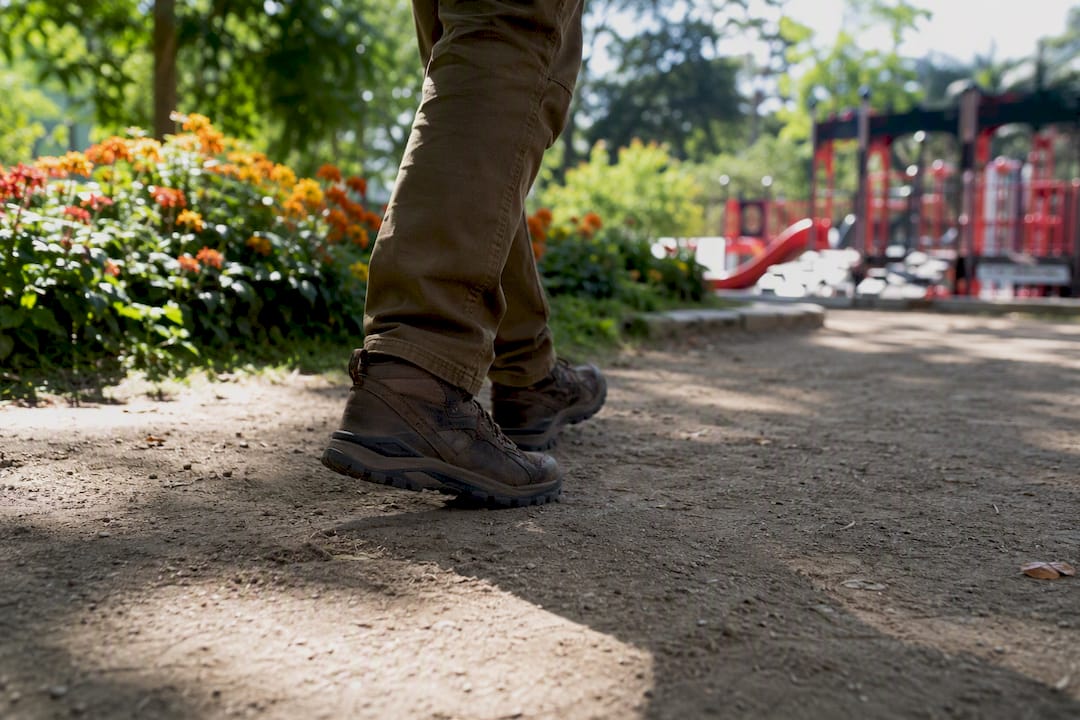
Movement discipline means changing your pace and direction irregularly rather than sprinting in one visible line. Using natural cover, buildings, parked vehicles, treelines, breaks direct line of sight without requiring anything exotic. Military evasion doctrine treats movement and concealment as fundamental skills, and the same logic scales down to civilian situations: don’t be predictable, don’t be loud, and don’t stay in open sightlines longer than necessary.
Route selection matters as much as speed. A straight sprint down a main road is easy to track. Cutting through varied terrain, changing surfaces, doubling back briefly, makes following you harder without slowing you down much. None of this requires specialized equipment, just awareness that being seen and being heard are two separate risks worth managing separately.
Psychological preparedness and mindset for high-stress escape scenarios
Technique alone doesn’t get people to safety. A calm, disciplined mindset does the rest of the work, and it’s the piece most self-defence conversations skip entirely.
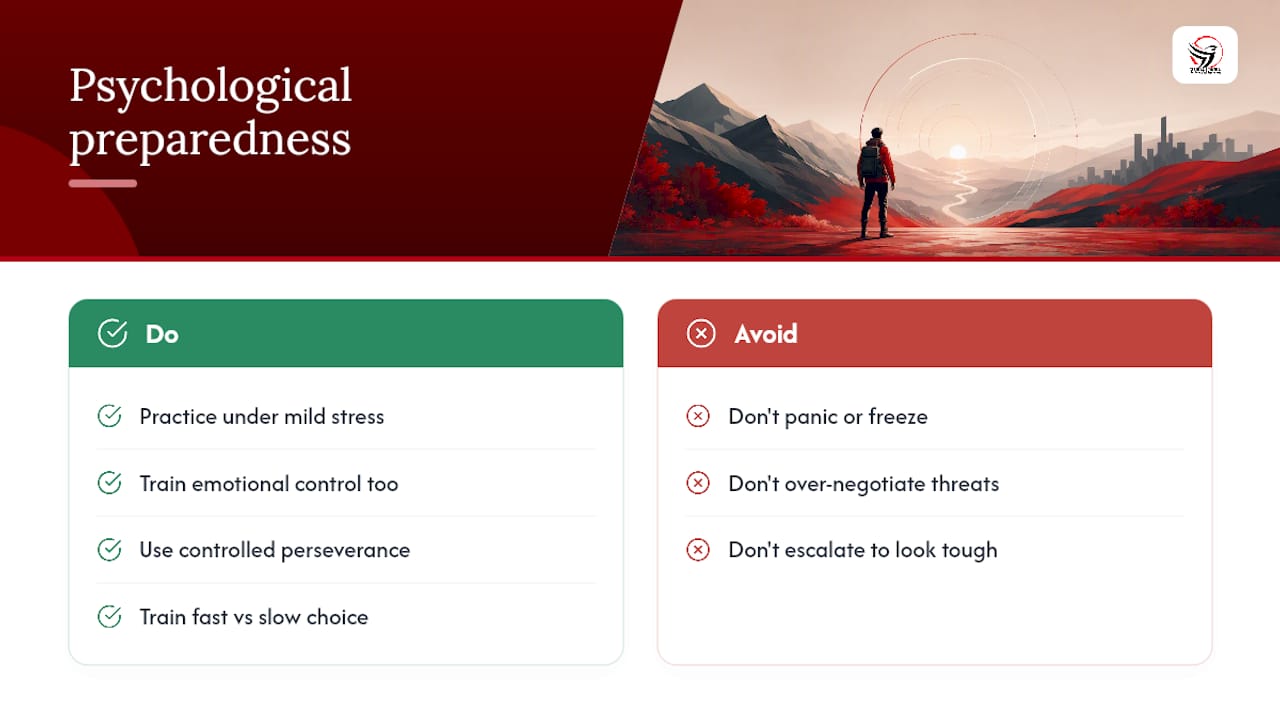
Panic is the single biggest thing that undermines an otherwise workable escape plan. Someone who has rehearsed a grip break a hundred times in training can still freeze the first time it’s needed for real, simply because the body’s stress response hijacks fine motor control. That’s not a character flaw. It’s physiology, and it’s exactly why stress inoculation (practising under mild, controlled pressure) matters more than perfecting technique in a vacuum.
A survivor mindset looks like controlled perseverance: sticking with a plan, adjusting when it doesn’t work, and resisting the urge to freeze or over-negotiate with a threat that has already shown its intent. In some restraint situations, a calm and methodical approach can take several minutes to work, which runs counter to the instinct to panic and thrash. Both fast and slow escape methods have their place, and knowing which one the moment calls for is itself a trained skill, not something you figure out in the moment for the first time.
Ego is a quieter danger. Some people escalate a situation trying to appear tough or unwilling to back down, which turns an avoidable encounter into a dangerous one. Training that builds emotional control alongside physical technique addresses this directly, rather than treating aggression as a substitute for competence.
Safeguarding your digital footprint during evasion
Physical safety and digital safety are increasingly the same conversation. Someone trying to locate you can often do it faster through a phone than through physical tracking.
Turn off location sharing on social apps, and check which apps have background location permissions enabled at all. Many people forget that ride-share history, fitness-tracking apps, and even photo metadata can reveal patterns about where you live, work, or walk regularly. If you believe someone specific may be trying to track you, a factory reset on a shared or older device removes tracking software that’s harder to find manually.
Avoid posting real-time updates about your location during any unfolding safety situation, even in a private group chat. Screenshots get forwarded, and “private” is rarely as private as it feels in the moment. If you need to communicate your location to someone you trust, a direct call or text to one person beats a broader post every time.
Family sharing features, often turned on for convenience, deserve a periodic review. A setting meant to help a parent track a teenager can just as easily be exploited by someone else with access to the same account.
What the research actually supports
Most self-defence marketing oversells technique and undersells mindset. The evidence points the other way: panic defeats good technique constantly, while a calm, rehearsed response makes even simple moves effective. That’s the gap conventional advice tends to skip over, favouring flashy strikes instead of the boring, repeatable stuff that actually works under stress.
The conventional wisdom that a single class “teaches self-defence” doesn’t hold up. What holds up is short, intense, realistic practice followed by genuine repetition. Skills fade fast without it. A five-hour course gives you a real foundation, not a finished product, and treating it as the latter is where a lot of people set themselves up to freeze when it matters.
If there’s one thing to prioritize first, it’s this: don’t wait for perfect technique before you practise under any stress at all. Comfort with feeling uncomfortable, moving off-line while your heart rate spikes, speaking calmly while adrenaline floods your system, matters more than adding another strike to your repertoire. Train the nervous system, not just the muscles.
Book practical escape and evasion training with Streetsafeselfdefence
Streetsafeselfdefence brings training to you rather than asking you to find a gym or dojo that fits your schedule. That’s the real difference for a school, workplace, or family trying to build these skills quickly: no facility rental, no travel time, no generic curriculum built for a different audience.
Courses run five hours and cover situational awareness, grip escapes, off-line movement, and one realistic scenario, delivered by trauma-informed instructors at your location. Groups range from individual bookings to full school assemblies or corporate teams, with class structure adjusted to fit the audience and any accessibility needs flagged ahead of time.
Pro Tip: Ask participants to wear the clothing and footwear they’d normally have on during their actual routine, work clothes, school uniforms, whatever’s realistic, so the movements they practise match what they’d actually be wearing if it mattered.
Booking starts with a short conversation about your group size and goals. Visit the self defence training at home page to see how a session is structured and request a date.
Frequently asked questions
What does escape and evasion mean in a self-defence context?
It means the combination of skills that let someone break free from a grab or hold, create distance from a threat, and move to safety, rather than techniques aimed at overpowering an attacker.
Can escape and evasion skills really be learned in a few hours?
A five-hour focused session builds real foundational reflexes for the most common grabs and holds, though skills fade without ongoing practice like periodic refreshers and short drills.
Is verbal de-escalation always the right first move?
It’s worth attempting when the other person still has room to back down, but it isn’t reliable once a situation has already turned physical or the other person shows clear intent to harm.
What should I carry to support evasion and personal safety?
A charged phone, a whistle, and awareness of local rules around any self-defence tool are sensible basics; check regional regulations before carrying anything marketed specifically as a weapon.
How do I know if a self-defence course is trauma-informed?
Ask directly how the instructor handles consent around physical contact, how they support participants with a trauma history, and whether pacing is adjustable for individual comfort levels.
Sources
- Escape and evasion field notes (excerpts)
- US Marine Corps Survival, Evasion and Recovery manual (MCRP‑3‑02H)
